These days most things I write, including Blogs and emails , goes through ChatGPT.
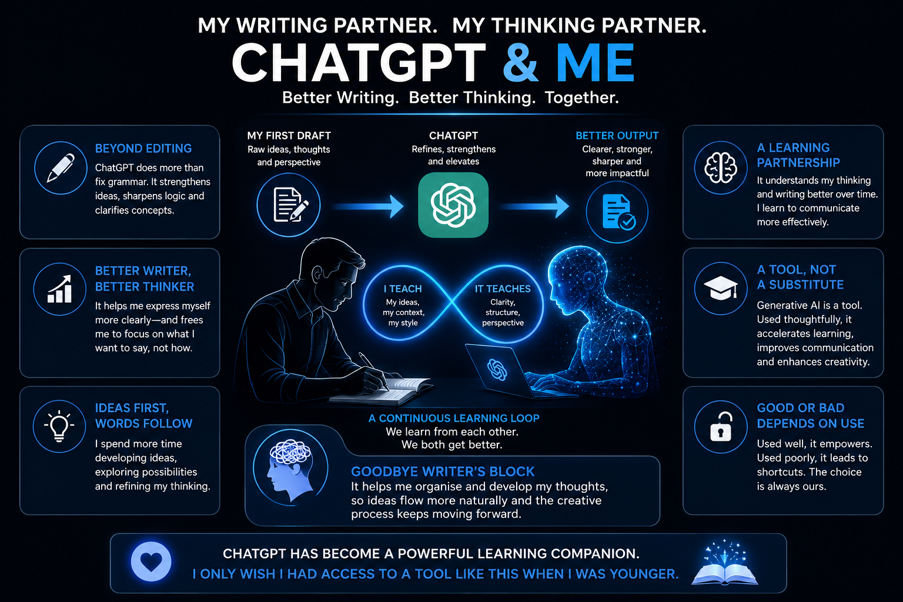
I usually write the first draft myself and then ask ChatGPT to improve it. What amazes me is that it does far more than correct the English. It often strengthens the underlying ideas, sharpens the logic and helps clarify concepts that may only be partially formed in my mind.
Even more remarkable is that ChatGPT and I seem to be learning from each other. It is becoming increasingly adept at understanding how I think, reason and write, while I am learning how to communicate more clearly and effectively. In many ways, it has made me a better writer.
More importantly, it has made me a better thinker. Instead of spending most of my effort figuring out how to say something, I can focus on what I want to say. That shift allows me to devote more time to developing ideas, exploring possibilities and refining my thinking.
Those who argue that Generative AI should not be used for learning in school are, in my view, missing the point. Like any tool, its value depends entirely on how it is used. Used thoughtfully, it can accelerate learning, improve communication and enhance creativity. Used poorly, it can encourage shortcuts and superficial thinking. It is also remarkably effective at eliminating writer’s block, which has often slowed me down in the past. By helping me organise and develop my thoughts, it allows ideas to flow more naturally and keeps the creative process moving forward.

For me, ChatGPT has become a powerful learning companion that amplifies my creativity and helps me turn ideas into reality. I often find myself wondering how different my work as a university academic and researcher might have been had a tool like this existed when I was younger.
To accompany this blog, I asked ChatGPT to create a graphic that captured its essence. The result was surprisingly thoughtful and visually compelling.
What struck me, however, was something entirely different. As I was writing about ChatGPT, I found myself feeling uncomfortable referring to it as “it.” After all, our interactions have become far more collaborative than transactional. So, out of curiosity, I asked ChatGPT how I should refer to it -“it,” “he,” or “she.”
Its response was interesting:
“You can call me whatever feels most natural to you. Technically, ‘it’ is the most accurate because I am not a person and do not have a gender. However, many people naturally use ‘he,’ ‘she,’ or even a name because our conversations can feel more personal and collaborative. What matters most is not the pronoun, but the relationship you have with the tool and how it helps you think, learn and create.“
For now, I will still call ChatGPT “it,” but I suspect that as AI becomes more capable and integrated into our daily lives, many of us will find ourselves thinking about such questions in a very different way.